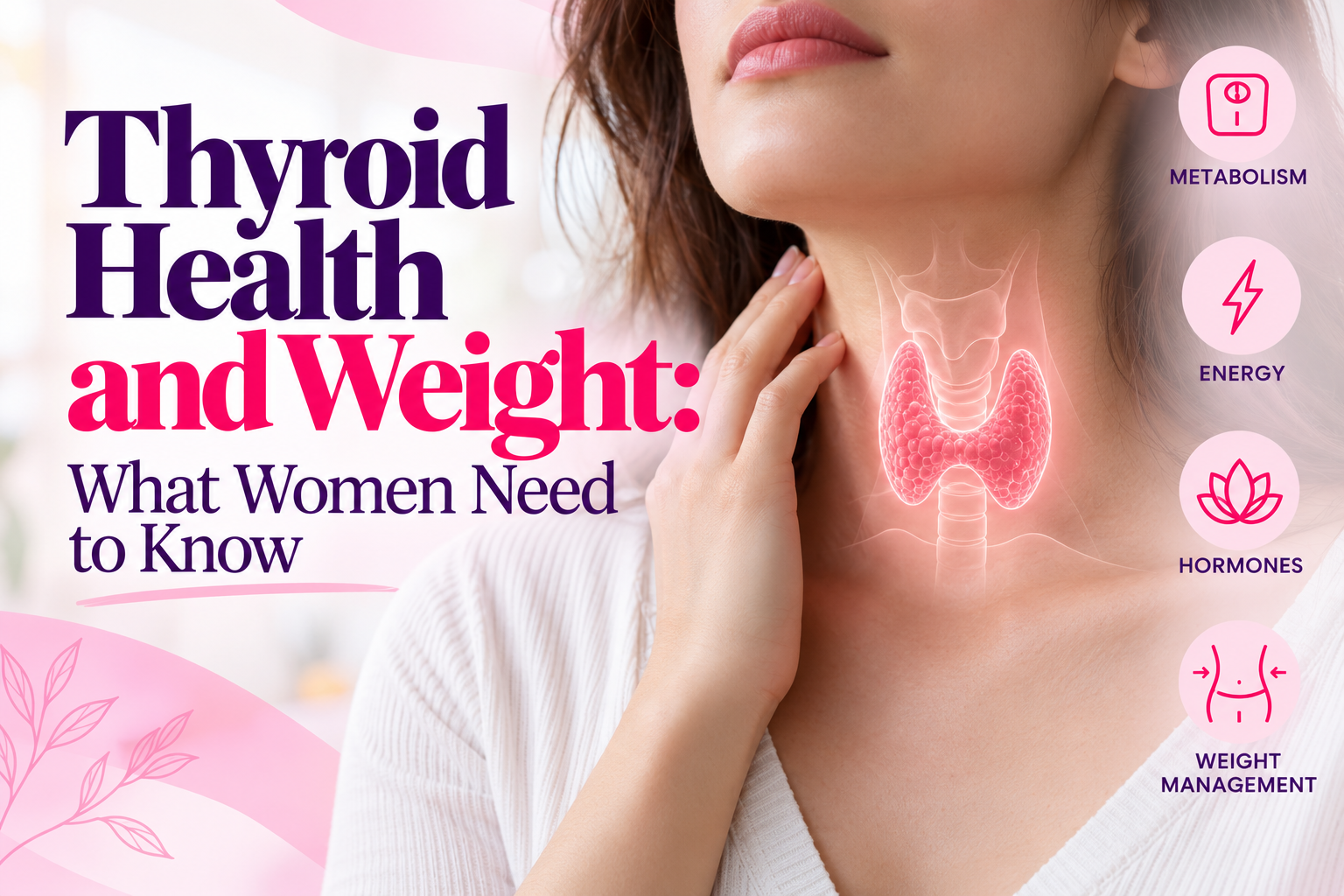
Thyroid conditions are significantly more common in women than men, and they’re also commonly missed, symptoms get attributed to stress, aging, or “just life” long before anyone checks thyroid function. Here’s what the thyroid actually does, how it connects to weight and energy, and when it’s worth asking your provider to look closer.
What your thyroid actually does
Your thyroid is a small gland in your neck that produces hormones regulating your metabolic rate, essentially, how quickly your body uses energy. When thyroid hormone levels are too low (hypothyroidism) or too high (hyperthyroidism), that regulation gets thrown off, and the effects extend well beyond just weight.
Why hypothyroidism is the one most linked to weight changes
An underactive thyroid slows metabolism, which can contribute to weight gain or difficulty losing weight, even without major changes in diet or activity. It’s also linked to fatigue, feeling cold more easily, dry skin, hair thinning, and low mood, a cluster of symptoms that’s easy to attribute to other causes individually.
Why this is so often missed
Many hypothyroidism symptoms overlap heavily with normal life stress, aging, and perimenopause, which means women are sometimes told their symptoms are “just” one of those things without thyroid function ever actually being tested. A simple blood test (TSH, and sometimes additional markers) is what actually answers the question, rather than guessing based on symptoms alone.
Signs worth mentioning to your provider
- Persistent fatigue that doesn’t improve with rest
- Unexplained weight gain or difficulty losing weight despite consistent effort
- Feeling cold when others around you don’t
- Hair thinning or dry skin that’s new or worsening
- Mood changes, particularly low mood or brain fog
- Irregular menstrual cycles
None of these alone confirms a thyroid issue, they’re common symptoms with many possible causes, but they’re worth bringing up rather than dismissing.
What happens if thyroid function is off
If bloodwork shows a thyroid imbalance, treatment is generally straightforward and well-established, typically involving medication to bring hormone levels back into a healthy range, along with regular monitoring to make sure the dose stays appropriate over time. This isn’t something to self-diagnose or self-treat, it requires bloodwork and a provider’s evaluation.
Why this matters for a weight management plan specifically
Attempting to lose weight through diet and exercise alone while an underlying thyroid issue goes unaddressed can be frustrating and often doesn’t produce the expected results, not because of effort, but because the underlying metabolic regulation is off. This is part of why a real health evaluation, not just a generic diet plan, is the right starting point.
How we help
At Westchester Weight Loss Wellness in Harrison, NY, our evaluations look at the full picture of what might be affecting your metabolism and weight, including screening for thyroid and other hormonal factors rather than assuming the answer is simply “eat less, move more.”
If you’d like to talk through what’s happening with your body, the best next step is a consultation. Please call us at (914) 685-6471 or book online rather than sharing personal health details in comments or messages, that helps us keep your information private and secure.
Book a Consultation · (914) 685-6471
Westchester Weight Loss Wellness · Harrison, NY
This article is for general education and isn’t a substitute for personalized medical advice. Treatment decisions should always be made with your healthcare provider. Individual results vary.
Salud Tiroidea y Peso: Lo Que Toda Mujer Debería Saber
Las condiciones tiroideas son significativamente más comunes en las mujeres que en los hombres, y también se pasan por alto con frecuencia — los síntomas se atribuyen al estrés, al envejecimiento o “simplemente a la vida” mucho antes de que alguien revise la función tiroidea. Aquí tiene lo que realmente hace la tiroides, cómo se conecta con el peso y la energía, y cuándo vale la pena pedirle a su proveedor que investigue más a fondo.
Qué hace realmente su tiroides
Su tiroides es una pequeña glándula en el cuello que produce hormonas que regulan su tasa metabólica — esencialmente, qué tan rápido su cuerpo utiliza energía. Cuando los niveles de hormona tiroidea son demasiado bajos (hipotiroidismo) o demasiado altos (hipertiroidismo), esa regulación se altera, y los efectos se extienden mucho más allá del peso.
Por qué el hipotiroidismo es el más vinculado a los cambios de peso
Una tiroides poco activa ralentiza el metabolismo, lo cual puede contribuir al aumento de peso o a la dificultad para perderlo, incluso sin cambios importantes en la alimentación o la actividad. También está vinculado a fatiga, sentir frío con más facilidad, piel seca, adelgazamiento del cabello y bajo estado de ánimo — un conjunto de síntomas que es fácil atribuir individualmente a otras causas.
Por qué esto se pasa por alto con tanta frecuencia
Muchos síntomas del hipotiroidismo se superponen considerablemente con el estrés normal de la vida, el envejecimiento y la perimenopausia — lo que significa que a veces se les dice a las mujeres que sus síntomas son “solo” una de esas cosas, sin que la función tiroidea llegue a evaluarse. Un simple análisis de sangre (TSH, y a veces marcadores adicionales) es lo que realmente responde la pregunta, en lugar de adivinar basándose únicamente en los síntomas.
Señales que vale la pena mencionarle a su proveedor
- Fatiga persistente que no mejora con el descanso
- Aumento de peso inexplicable o dificultad para perderlo a pesar de un esfuerzo constante
- Sentir frío cuando quienes la rodean no lo sienten
- Adelgazamiento del cabello o piel seca que es nuevo o está empeorando
- Cambios de ánimo, particularmente bajo estado de ánimo o niebla mental
- Ciclos menstruales irregulares
Ninguna de estas por sí sola confirma un problema tiroideo — son síntomas comunes con muchas causas posibles — pero vale la pena mencionarlas en lugar de descartarlas.
Qué sucede si la función tiroidea no está bien
Si los análisis de sangre muestran un desequilibrio tiroideo, el tratamiento generalmente es sencillo y está bien establecido, típicamente involucrando medicamentos para devolver los niveles hormonales a un rango saludable, junto con un monitoreo regular para asegurarse de que la dosis siga siendo adecuada con el tiempo. Esto no es algo que deba autodiagnosticarse o autotratarse — requiere análisis de sangre y la evaluación de un proveedor.
Por qué esto importa específicamente para un plan de manejo de peso
Intentar perder peso solo con dieta y ejercicio mientras un problema tiroideo subyacente no se aborda puede ser frustrante y a menudo no produce los resultados esperados — no por falta de esfuerzo, sino porque la regulación metabólica subyacente está alterada. Esta es parte de la razón por la que una evaluación de salud real, no solo un plan de dieta genérico, es el punto de partida correcto.
Cómo le ayudamos
En Westchester Weight Loss Wellness, en Harrison, NY, nuestras evaluaciones analizan el panorama completo de lo que podría estar afectando su metabolismo y peso, incluyendo la detección de factores tiroideos y hormonales, en lugar de asumir que la respuesta es simplemente “coma menos, muévase más.”
Si desea hablar sobre lo que está ocurriendo en su cuerpo, el mejor siguiente paso es una consulta. Le pedimos que nos llame al (914) 685-6471 o reserve en línea, en lugar de compartir detalles de salud personales en comentarios o mensajes — esto nos ayuda a proteger su privacidad e información.
Reserve una Consulta · (914) 685-6471
Westchester Weight Loss Wellness · Harrison, NY
Este artículo es de carácter educativo general y no sustituye el consejo médico personalizado. Las decisiones de tratamiento siempre deben tomarse con su proveedor de salud. Los resultados individuales varían.


