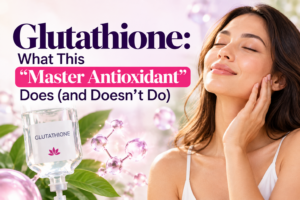
Glutathione has a big reputation online: “master antioxidant,” “ultimate detox,” “skin-brightening miracle.” Some of that reputation is grounded in real biology, and some of it is marketing. Here’s a clear look at what glutathione actually is, what it may help support, and where we think the claims go too far.
What glutathione actually is
Glutathione is a compound your body makes naturally, built from three amino acids. It’s found in nearly every cell and plays a central role in the body’s own antioxidant defenses, helping neutralize unstable molecules called free radicals that build up through normal metabolism, stress, and environmental exposure.
Why people talk about it so much
Because glutathione is involved in so many cellular processes, including antioxidant defense, immune function, and the body’s natural detoxification pathways, it’s become a popular topic in wellness and healthy aging conversations. Natural levels also tend to decline with age, which adds to the interest.
What it may help support
When used as part of an overall wellness approach, glutathione may help support:
- The body’s natural defense against oxidative stress
- Normal immune system function
- The body’s own detoxification processes
- General cellular health and energy
“May help support” is the right phrase here. Research on glutathione supplementation, especially in people who are otherwise healthy, is still developing, and individual response varies.
Where the hype goes too far
- “Detox in a bag.” Your liver and kidneys already handle detoxification around the clock. Glutathione may help support those natural processes, but it doesn’t replace them or “flush” anything on its own.
- “Skin whitening” and complexion claims. Glutathione is popular in beauty routines, but the evidence for dramatic changes in skin appearance is limited and mixed, and no result can be promised.
- “Reverses aging.” No glutathione treatment has been shown to reverse aging in humans.
We’d rather tell you this plainly than oversell something.
What actually supports your body’s own glutathione
Your lifestyle has a large influence on your natural antioxidant defenses. Regular physical activity, adequate protein (the building blocks your body uses to make glutathione), a diet rich in colorful fruits and vegetables, quality sleep, and limiting alcohol and smoking all matter. A glutathione therapy session is best thought of as a possible complement to those basics, not a substitute for them.
Who may want to talk with a provider about it
Glutathione therapy tends to interest people who are generally healthy and looking for wellness and healthy aging support. It isn’t right for everyone. Certain health conditions, medications, and allergies can make it inappropriate, which is why a health history review comes first.
How we help
At Westchester Weight Loss Wellness in Harrison, NY and Stamford, CT, glutathione therapy is nurse-led and medically supervised. We start with a conversation about your health history and goals, explain honestly what it may and may not do, and help you decide whether it fits into a broader plan.
If you’re curious whether glutathione therapy could be a good fit, the best next step is a consultation. Please call us at (914) 685-6471 or book online rather than sharing personal health details in comments or messages. That helps us keep your information private and secure.
Book a Consultation · (914) 685-6471
Westchester Weight Loss Wellness · Harrison, NY & Stamford, CT
This article is for general education and isn’t a substitute for personalized medical advice. Treatment decisions should always be made with your healthcare provider. Individual results vary.
Glutatión: Qué Hace (y Qué No Hace) Este “Antioxidante Maestro”
El glutatión tiene una gran reputación en línea: “antioxidante maestro,” “desintoxicación definitiva,” “milagro para aclarar la piel.” Parte de esa reputación se basa en biología real, y parte es marketing. Aquí tiene una mirada clara sobre qué es realmente el glutatión, qué puede ayudar a apoyar y dónde creemos que las afirmaciones se exceden.
Qué es realmente el glutatión
El glutatión es un compuesto que su cuerpo produce de forma natural, formado por tres aminoácidos. Se encuentra en casi todas las células y desempeña un papel central en las defensas antioxidantes del propio cuerpo, ayudando a neutralizar moléculas inestables llamadas radicales libres que se acumulan por el metabolismo normal, el estrés y la exposición ambiental.
Por qué se habla tanto de él
Debido a que el glutatión participa en tantos procesos celulares, incluyendo la defensa antioxidante, la función inmunológica y las vías naturales de desintoxicación del cuerpo, se ha convertido en un tema popular en las conversaciones sobre bienestar y envejecimiento saludable. Los niveles naturales también tienden a disminuir con la edad, lo que aumenta el interés.
Qué puede ayudar a apoyar
Cuando se utiliza como parte de un enfoque de bienestar integral, el glutatión puede ayudar a apoyar:
- La defensa natural del cuerpo contra el estrés oxidativo
- El funcionamiento normal del sistema inmunológico
- Los procesos de desintoxicación propios del cuerpo
- La salud celular y la energía en general
“Puede ayudar a apoyar” es la frase correcta aquí. La investigación sobre la suplementación con glutatión, especialmente en personas que por lo demás están sanas, todavía está en desarrollo, y la respuesta individual varía.
Dónde la exageración va demasiado lejos
- “Desintoxicación en una bolsa.” Su hígado y sus riñones ya se encargan de la desintoxicación las 24 horas. El glutatión puede ayudar a apoyar esos procesos naturales, pero no los reemplaza ni “elimina” nada por sí solo.
- Afirmaciones sobre “blanqueamiento” de la piel y el cutis. El glutatión es popular en las rutinas de belleza, pero la evidencia de cambios dramáticos en la apariencia de la piel es limitada y mixta, y no se puede prometer ningún resultado.
- “Revierte el envejecimiento.” Ningún tratamiento con glutatión ha demostrado revertir el envejecimiento en humanos.
Preferimos decírselo con claridad en lugar de exagerar.
Qué apoya realmente el glutatión de su propio cuerpo
Su estilo de vida tiene una gran influencia en sus defensas antioxidantes naturales. La actividad física regular, una proteína adecuada (los bloques de construcción que su cuerpo usa para producir glutatión), una alimentación rica en frutas y verduras de colores, un sueño de calidad y limitar el alcohol y el tabaco, todo importa. Una sesión de terapia con glutatión se piensa mejor como un posible complemento de esos fundamentos, no como un sustituto.
Quiénes pueden querer conversar con un proveedor al respecto
La terapia con glutatión suele interesar a personas que gozan de buena salud en general y buscan apoyo para el bienestar y el envejecimiento saludable. No es adecuada para todos. Ciertas condiciones de salud, medicamentos y alergias pueden hacerla inapropiada, por eso primero se revisa su historial de salud.
Cómo le ayudamos
En Westchester Weight Loss Wellness, en Harrison, NY y Stamford, CT, la terapia con glutatión es dirigida por enfermería y con supervisión médica. Comenzamos con una conversación sobre su historial de salud y sus metas, le explicamos con honestidad qué puede y qué no puede hacer, y le ayudamos a decidir si encaja en un plan más amplio.
Si tiene curiosidad por saber si la terapia con glutatión podría ser una buena opción, el mejor siguiente paso es una consulta. Le pedimos que nos llame al (914) 685-6471 o reserve en línea, en lugar de compartir detalles de salud personales en comentarios o mensajes. Esto nos ayuda a proteger su privacidad e información.
Reserve una Consulta · (914) 685-6471
Westchester Weight Loss Wellness · Harrison, NY y Stamford, CT
Este artículo es de carácter educativo general y no sustituye el consejo médico personalizado. Las decisiones de tratamiento siempre deben tomarse con su proveedor de salud. Los resultados individuales varían.